The City That Rises From the Desert
The approach to Jaisalmer is part of the experience, and it begins well before you arrive.
The landscape changes gradually as you come in from Jodhpur or wherever you are travelling from. The vegetation thins. The colours soften into the shades of sand and pale stone. The distances between things — between buildings, between towns, between the road and the horizon — grow wider, and with them comes a particular quality of quiet that you don’t find in most Indian cities.
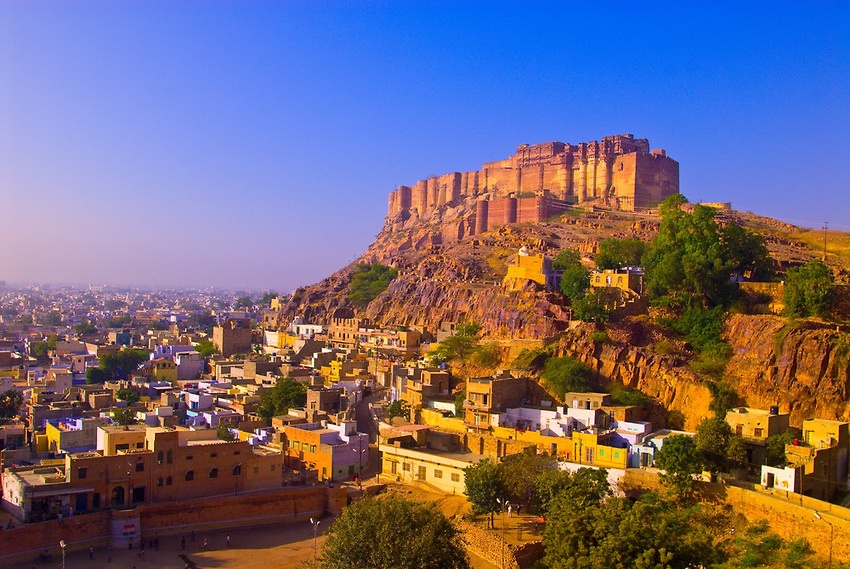
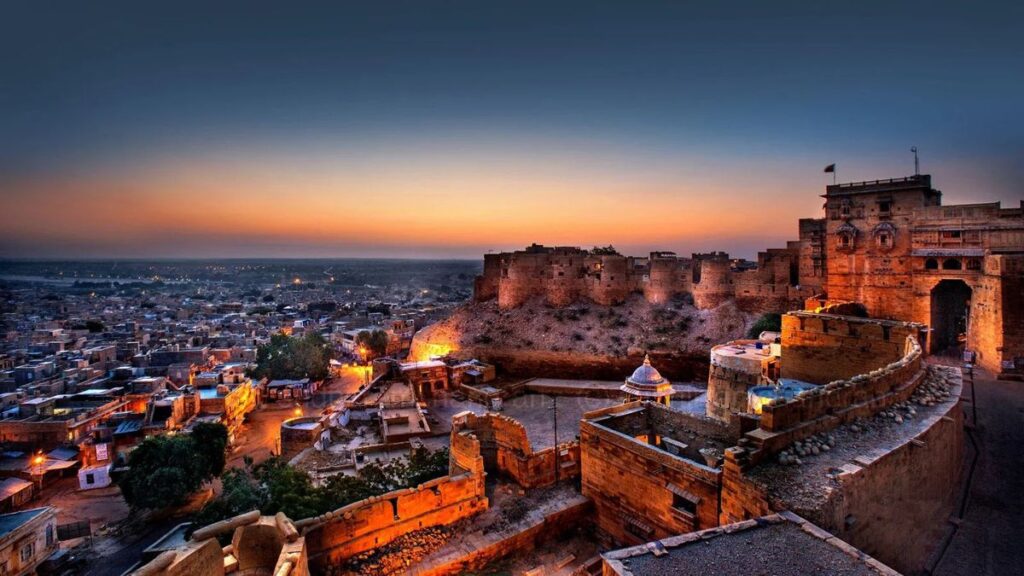
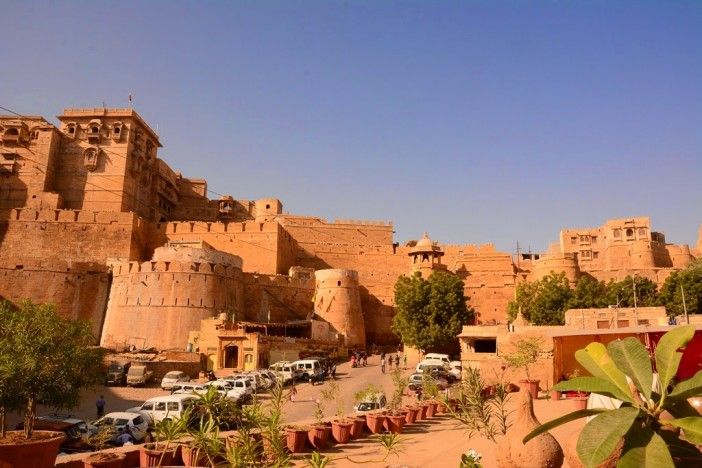
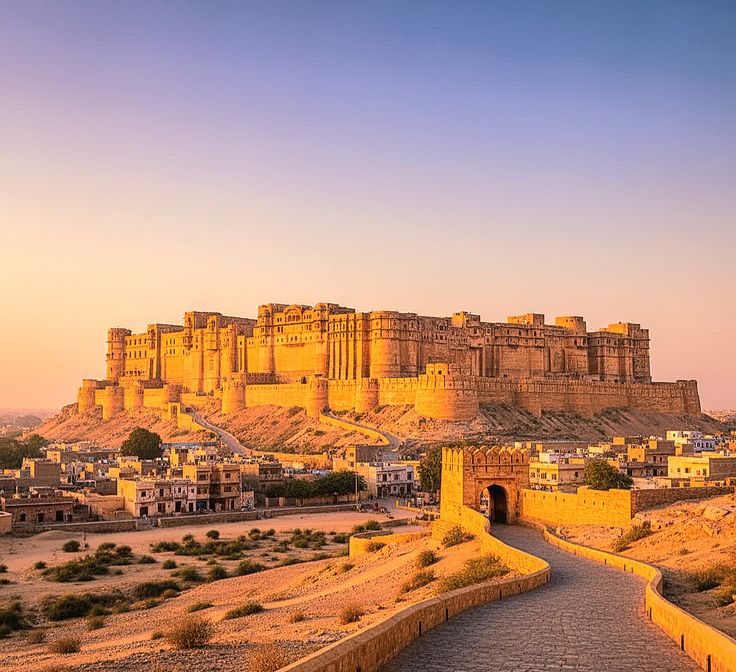
And then the fort appears. Not announcing itself dramatically from a separate hill the way Jodhpur’s Mehrangarh does, but rising from the desert floor in the same golden-yellow sandstone as the land around it. From a distance, the distinction between the fort and the desert is genuinely unclear. It looks less like something built upon the landscape and more like something that grew from it.
This quality — the sense that Jaisalmer exists within its environment rather than against it — shapes everything about how the city feels and what it asks of you. It is not a city that rewards constant movement or dense sightseeing schedules. It is a city that rewards pace, attention, and the willingness to let silence do some of the work.
What Jaisalmer Is and Isn’t
Founded in 1156 by Rawal Jaisal, Jaisalmer developed as a trading post along the ancient desert caravan routes that connected India to Central Asia and beyond. For centuries it was a prosperous city precisely because of its position — merchants and goods passing through the Thar Desert needed a waypoint, and Jaisalmer was it. The wealth that passed through the city left its mark in the fort’s palace rooms, in the extraordinary havelis built by merchant families, and in the quality of craftsmanship that seems disproportionate to the remoteness of the location.
The trade routes are long gone, and the city they built has turned inward. What remains is smaller and quieter than Jaipur or Jodhpur — fewer major sites, a more contained old city, a pace that has more in common with the desert around it than with the bustle of Rajasthan’s more famous destinations.
This is not a limitation. It is the character of the place. Travellers who arrive expecting the same density of experience as Jaipur will find Jaisalmer insufficient. Travellers who arrive understanding that the city operates on a different register — one where the quality of a single hour sitting on a fort rampart at the right time of day is the point, not a consolation prize for having run out of monuments — will find it one of the most satisfying places in Rajasthan.
When to Go — The Climate Is Not Optional
Jaisalmer is a desert city in the full sense of that phrase, and the timing of a visit matters more here than at almost any other Rajasthan destination.
October through February is the window when Jaisalmer works. The days are warm and comfortable, the evenings cool down to genuinely pleasant temperatures, and the desert — which is the reason many people make the journey — is a place you can spend extended time in without the heat becoming the dominant fact of the experience. December and January are the busiest months and bring the highest concentration of visitors to the Sam Sand Dunes, but they also offer the best balance of weather, visibility, and the kind of desert atmosphere that most people are imagining when they plan the trip.
From March onwards, the temperature begins its climb, and by April and May it has reached levels that change the experience categorically. The fort walls absorb and radiate heat. The desert becomes hostile in the middle hours. The havelis, which in November you can walk around for an hour in the morning sun, require a different strategy entirely when the same sun is at full summer strength. A summer visit to Jaisalmer is possible but requires complete reorganisation around the heat — early mornings, long midday breaks, late afternoons.
The honest advice is to treat October through February not as the preferred window but as essentially the only window unless your schedule genuinely cannot accommodate it.
The Fort — Living History, Not a Monument
Jaisalmer Fort is not, in the way that most forts are, something you visit from outside. You enter it, and once inside, you are in a place where people actually live.
This distinction is fundamental to understanding what the fort is. Unlike Amber Fort in Jaipur or Mehrangarh in Jodhpur — both extraordinary, both essentially museums of Rajput power and craft — Jaisalmer Fort contains a functioning neighbourhood. Families live in houses built into the fort walls. Small temples conduct daily worship. Cafés and shops operate along lanes that are genuinely narrow and genuinely medieval in their proportions. The fort is inhabited, and that inhabitation is not a historical quirk or a managed heritage decision — it is simply how things are.
Walking through it means encountering this layered quality directly: old stone and daily life occupying the same space without apparent contradiction. There is no clear moment where you cross from the historical to the contemporary, because the two are not separated here. A carved doorway from the fourteenth century opens onto a lane where laundry is drying. A merchant’s courtyard from the sixteenth century contains a family’s afternoon. The fort exists in continuous time rather than as a preserved slice of it.
Move through the fort slowly and without a fixed sequence. The Raj Mahal palace complex, the Jain temples within the fort walls — which are detailed and beautifully maintained and consistently undervisited — and the rampart walkways with their views over the rooftops and out into the desert are all worth extended time. But the fort also rewards wandering into lanes that are not on any map, stopping where something interests you, and letting the place show itself at its own pace.
A note on the fort’s conservation situation: the combination of a living population, tourist footfall, and water drainage challenges has created genuine structural concerns in parts of the fort. Some sections have been damaged over the years. Respect any marked restricted areas — this is not bureaucratic caution but the preservation of something that cannot be rebuilt.
The Havelis — Where Craft Becomes the Point
Outside the fort, in the streets of the old city, Jaisalmer’s merchant havelis offer a different kind of encounter with the city’s history.
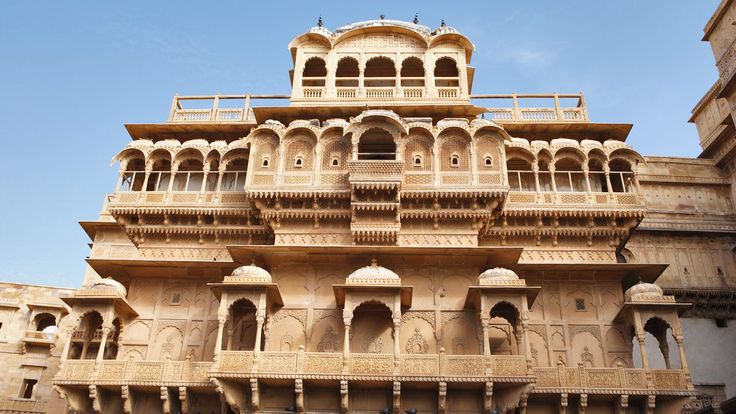
Patwon ki Haveli — a complex of five connected havelis built by a wealthy Jain merchant family in the early nineteenth century — is the most elaborate and the most visited. Nathmal ki Haveli, slightly smaller and slightly less crowded, shows you the same quality of craftsmanship in a context that feels less managed. Both reward proximity.
The detail in these buildings is not decorative in the casual sense. It is the primary expression of wealth and status in a culture where the carving of sandstone was one of the highest art forms, and the Jaisalmer yellow sandstone — softer and more workable than the red sandstone of eastern Rajasthan — allowed craftsmen to achieve a precision that reads, up close, more like fabric than like stone. Balconies that look simple from across the street reveal, when you stand beneath them, layers of geometric and figurative carving that go deeper the longer you look.
Give the havelis more time than your first instinct suggests. The standard experience is to photograph the facades from a distance and move on. The better experience is to stand directly under a balcony, look up at the underside of the stone carving, and understand that everything you are seeing was done by hand in a material that would crumble if the chisel was misjudged. That understanding changes what you are looking at.
Gadisar Lake — The Quiet Beginning
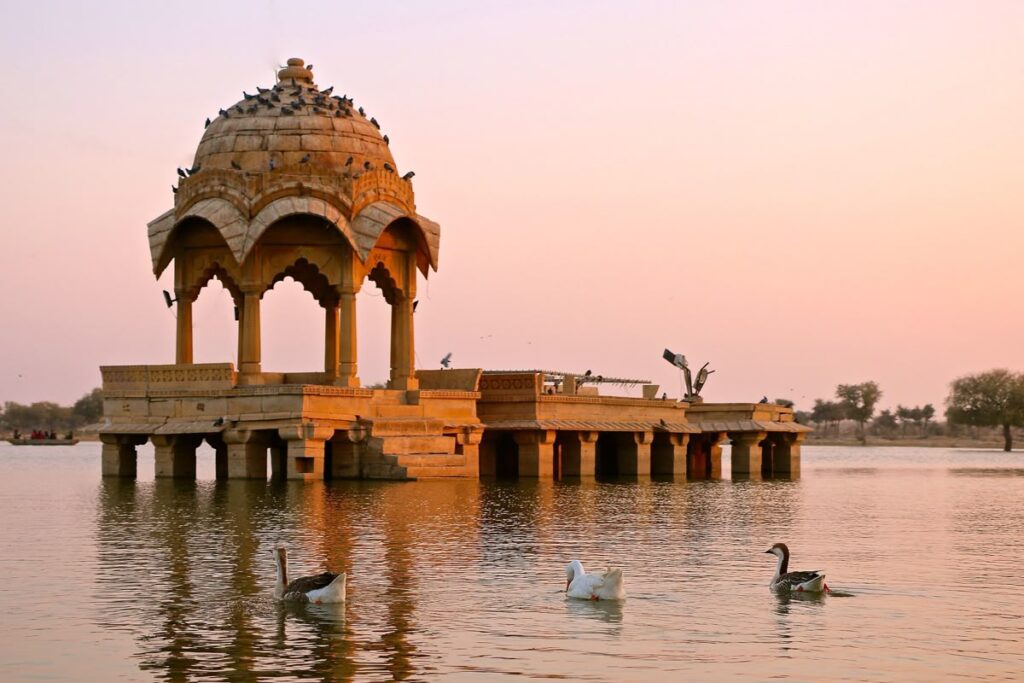
Gadisar Lake, just outside the old city walls, is the reservoir that supplied Jaisalmer with water for centuries — a human-made body of water surrounded by small temples, cenotaphs, and the ornamental gateway of Tilon ki Pol, built by a court dancer whose contributions to the city’s waterworks were so significant that the king eventually stopped trying to prevent her from adding her own gateway to the complex.
In the early morning, before the city has fully started its day, Gadisar is one of the most peaceful places in Jaisalmer. The water reflects the temples and gateways around it. Migratory birds are often present in the winter months. The noise level is minimal. It is a place that requires nothing of you except to be in it.
Visit it on your first morning, before going to the fort. It sets the right pace for everything that follows — a reminder that Jaisalmer moves slowly and that you should too.
The Desert — Where Most Trips Either Work or Don’t
The desert experience is the reason many people make the long journey to Jaisalmer, and it is the part of the visit most consistently done badly.
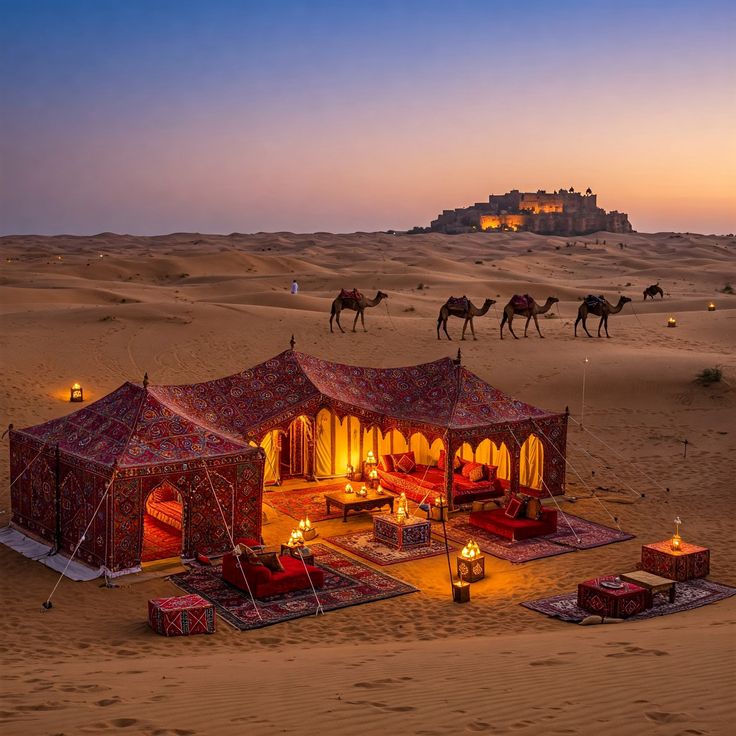
The standard version — jeep to the Sam Sand Dunes, camel ride, folk performance, dinner at a fixed camp, night in an air-conditioned tent, jeep back in the morning — produces an experience that is comfortable, photogenic, and essentially divorced from what a desert actually is. The infrastructure around Sam is substantial, the other tourist vehicles are visible from most of the popular dune positions, and the orchestrated nature of the cultural performance and the camp evening creates a version of the desert that has been designed to deliver satisfaction rather than encounter.
This version is not without value — the dunes at Sam are genuinely beautiful, particularly at sunrise and sunset, and a night in the desert under Rajasthan’s sky is worth having even in managed form. But it is worth being honest about what it is.
The better version takes a little more intention. Arrive at the dunes before the main tourist rush — late afternoon rather than at the organised sunset time. Walk away from the clusters of visitors and vehicles, even a short distance, and sit somewhere where the human activity is not the dominant fact of the scene. Stay quiet for long enough that the desert does what it does: expands. The scale of it, and the quality of silence that exists in genuinely open desert, requires time to register. It cannot be rushed into.
If you stay the night in the desert, the hours after the camp’s entertainment ends and the generator noise stops are when it becomes what it is. The temperature drops significantly. The sky at that distance from city light is different from any sky most visitors have seen. The morning, before the first light has fully arrived, is the version of the desert that stays with people longest.
The choice of where to stay matters substantially. The very large, very well-organised camps closest to Sam are efficient and comfortable and the most heavily booked. Smaller, quieter camps further from the main tourist concentration offer a different quality of experience. Ask your operator specifically about crowd levels and generator policies before booking. A quiet night in the desert is a different experience from a comfortable one, and if you have come this far, the quiet version is worth seeking.
How Many Days — and How to Use Them Honestly
Two nights is the minimum for Jaisalmer to make sense as a destination rather than a stop. Three nights is better, and the difference between two and three is felt most clearly in the quality of the fort time — with two nights, the fort is a long morning and an afternoon; with three, it becomes something you return to and know differently on the second visit.
The structure that works: a first morning at Gadisar Lake before the day’s heat and activity builds, followed by the fort in the late morning and afternoon. A second day weighted toward the havelis and the old city on foot — the lanes, the markets, the texture of daily life in Jaisalmer’s less photographed areas. A desert evening and overnight on the second or third night, with a sunrise return before the day properly begins. And throughout, less scheduled than feels comfortable when you are planning it, because the unplanned hours in Jaisalmer are consistently where the better memories are made.
Where to Stay — Three Different Experiences
Jaisalmer offers three meaningfully different accommodation positions, and the choice between them shapes the trip in ways worth thinking about before booking.
Staying inside the fort puts you inside the living history of the place — narrow lanes outside your door, the fort atmosphere at all hours, the particular quality of waking up inside walls that have been standing since the twelfth century. The trade-offs are real: the lanes are narrow and vehicle access is limited, facilities are simpler, and the ongoing conservation concerns mean that every additional person staying inside the fort adds incrementally to the water pressure that threatens its foundations. It is a genuine ethical question as well as a practical one, and it is worth factoring in honestly.
Staying outside the fort in the old city offers the atmosphere of Jaisalmer at slightly more comfortable remove — heritage properties with better facilities but the same golden sandstone character, easy walking access to the havelis and the fort entrance, and none of the conservation complications.
The desert camp, for those who want the night under the Rajasthan sky to be the centre of the experience, is its own category entirely.
Practical Notes
Getting there: Jaisalmer is approximately 290 kilometres from Jodhpur — a four to five hour drive — and well connected by overnight train from Jodhpur, Jaipur, and Delhi. The overnight train from Jodhpur is a practical and comfortable option that delivers you to Jaisalmer in the morning with the day ahead.
Getting around: The old city and fort area are walkable. For the desert and for the havelis if you prefer not to walk, jeeps and auto-rickshaws are available. The distances within the city are small enough that walking is almost always the better choice — it matches the pace of the place and allows you to notice things that a vehicle moves past.
Photography: Jaisalmer is one of the most photogenic cities in India and the light here — particularly the warm late-afternoon light on the fort and the havelis — is extraordinary. Early morning and the two hours before sunset are the primary windows. Midday photography in most seasons is flat and difficult.
Freedom Trail India plans private journeys through Jaisalmer and the broader Rajasthan desert circuit. If you are building a Rajasthan itinerary and want help designing the desert section properly — we are glad to help.