A Place That Opens Up Instead of Rising
Most mountain destinations in India are organised around altitude. You go up, the valley opens below, the horizon stretches outward, and the experience is defined by the scale of what you can see from above. The higher you go, the more you see, and seeing more is the point.
Khajjiar does not work this way.
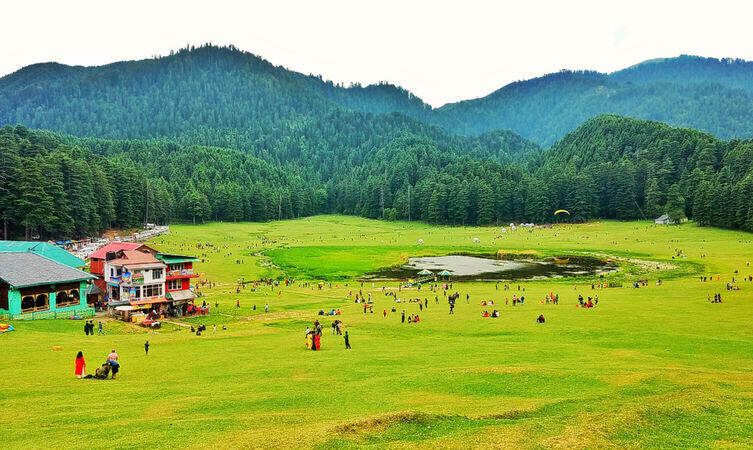
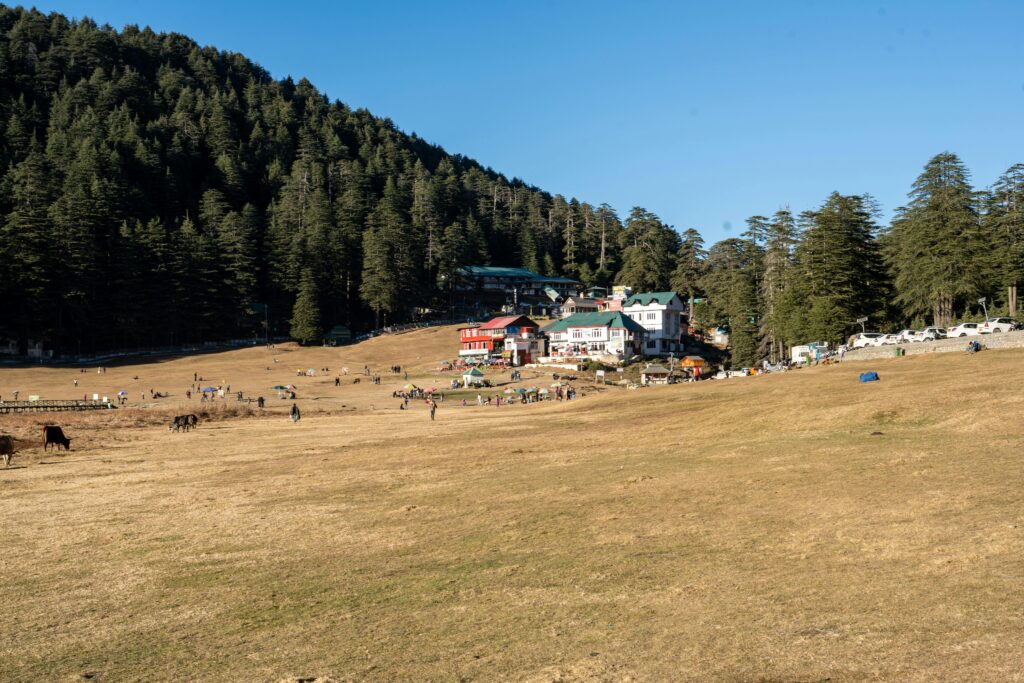
Instead of rising, it opens. The road through the Dhauladhar forest brings you out suddenly into a flat meadow — a natural clearing in the middle of dense deodar forest, the land holding itself level in a way that feels improbable at this altitude. There is no commanding view outward. The forest closes around three sides. A small water body sits at the centre. The horizon is the treeline rather than distant peaks.
This inward quality is either immediately understood or slightly confusing on first encounter. Travellers who arrive expecting the visual drama of a conventional mountain viewpoint find Khajjiar modest. Travellers who arrive understanding that the meadow itself is the thing — that the experience here is of being within a space rather than looking out from one — find it quietly extraordinary in a way that is difficult to explain but easy to remember.
What Khajjiar Actually Is
Khajjiar is not a town with a meadow at its centre. It is, more accurately, a meadow with a small settlement at its edge.
The central space — roughly circular, approximately one kilometre across, with the small Khajji Nag lake sitting at the middle — is the entire destination. Around it: dense deodar forest, the tree line defining the edge of the clearing the way walls define a room. At the southern end, a small temple to Khajji Nag, the serpent deity for whom the place is named, has been standing in various forms since the seventh century. A few small hotels and basic eating establishments occupy the peripheral area where the road meets the meadow.
That is genuinely the extent of it, and this is important to understand before arriving. There is no fort. No palace. No series of historical monuments to move between. The experience of Khajjiar is entirely about the meadow, the forest, the quality of the air at this altitude, and the particular feeling of a space that has not been developed beyond what the setting naturally accommodates.
This simplicity is not a deficiency. It is the point. Khajjiar works precisely because it does not try to be more than it is.
When to Go — Visual Character Over Comfort
Khajjiar changes character significantly across the year, and the different versions are different enough to warrant choosing deliberately rather than defaulting to convenience.
March through June is when the meadow is at its most vivid. The grass is green, the deodar trees have the particular deep colour of spring forest, and the days are long enough to spend extended time outdoors without the light fading before the experience has settled. This is the season when Khajjiar is busiest — families from the plains seeking escape from the pre-summer heat, travellers combining it with Dalhousie and Chamba. The crowds concentrate around the main meadow area during midday hours but thin toward the morning and evening edges of the day.
September through November is the post-monsoon version — arguably the more beautiful one. The rains have deepened the greens to a saturated intensity that the spring months do not match, the air has a clarity that comes after sustained rainfall, and the meadow has a richness of colour and texture that feels fully realised. The visitor numbers have reduced from the summer peak, and the quality of the space in these months — the light through the deodar forest, the reflection in the lake, the particular quietness of a high-altitude clearing in autumn — is excellent.
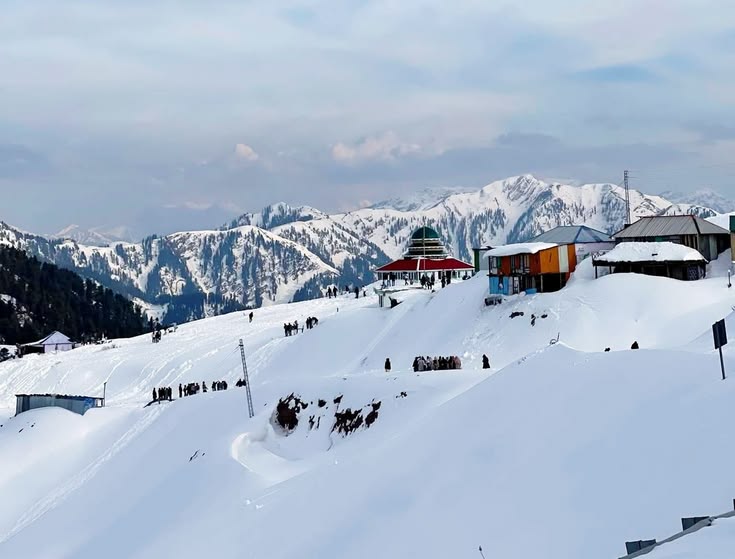
Winter brings snow, sometimes significantly, and converts the meadow into a landscape that is visually entirely different from any other version of the place. The same clearing that is green and open in June becomes white and enclosed in January, with the deodar forest around it changed by the weight of snow on the branches. This version of Khajjiar is quieter, colder, and genuinely beautiful in the way that snow-covered mountain landscapes are beautiful. Access can be restricted after heavy snowfall. Check road conditions before planning a winter visit and build flexibility into the itinerary.
The Meadow — Being Within It Rather Than Looking at It
The central meadow is not something you observe from a fixed point. It is something you move within, and the experience of it changes depending on where you are inside it and what time of day you are there.
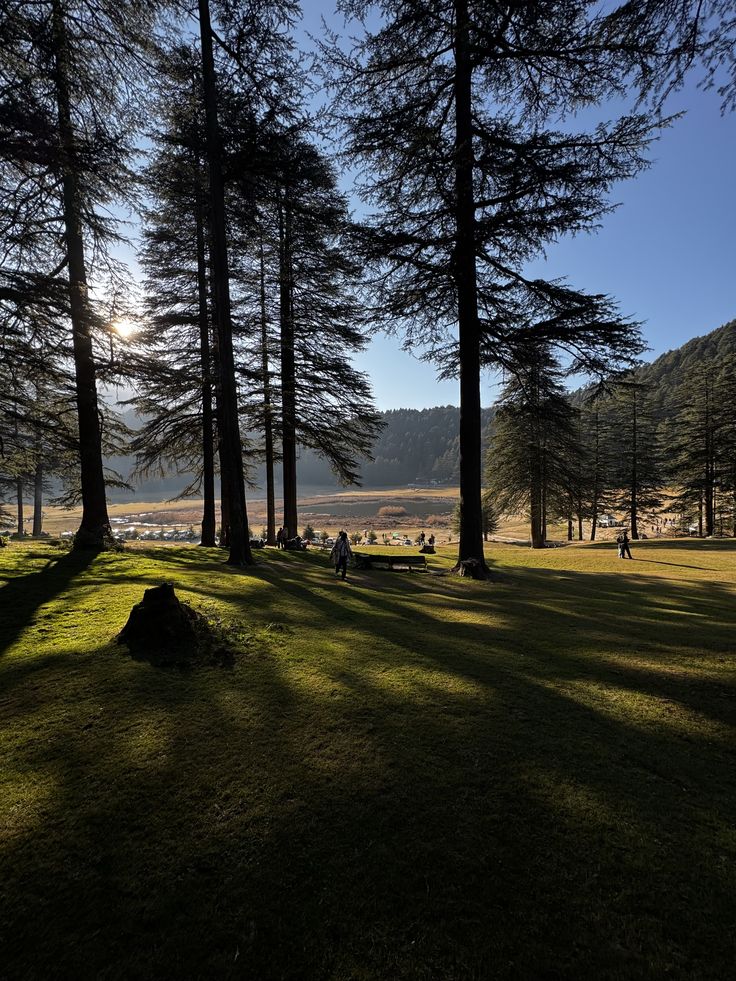
Walking the perimeter — following the edge of the clearing where the grass meets the treeline — takes perhaps twenty minutes at a casual pace. It gives you the meadow from all sides and the forest from its edge. The deodar trees at the boundary are large and old, the kind of trees that make their age apparent in the way that ancient things make their age apparent — through scale and a particular quality of presence. Walking into the forest even a short distance, where the light through the canopy changes and the sound of the meadow recedes, gives you a contrast that makes the openness of the clearing more legible when you return to it.
The Khajji Nag lake at the centre is small — more accurately a pond than a lake — but it performs a function within the landscape that is disproportionate to its size. It anchors the centre of the clearing, reflects the sky and the surrounding treeline, and gives the meadow a focal point without dominating it. Sitting at its edge in the morning, when the surface is still and the reflection is clear, is one of those simple experiences that stays in the memory more reliably than more obviously dramatic ones.
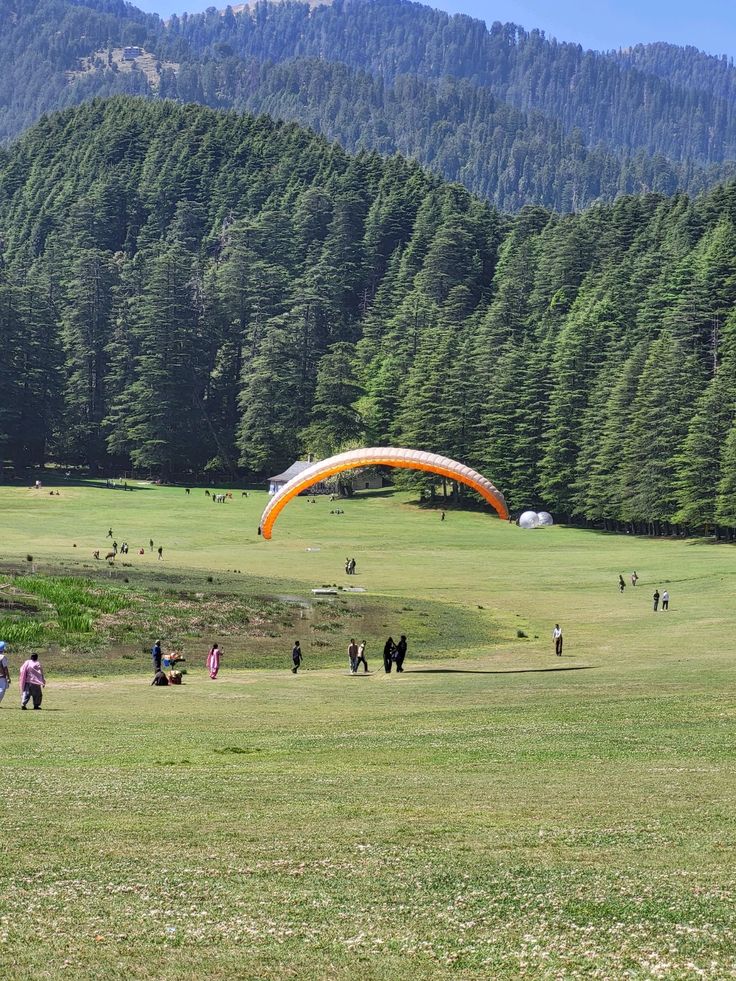
The morning and the evening are when the meadow is at its best, and this is worth organising the visit around deliberately. In the middle hours of the day, particularly during peak season, the main meadow area fills with visitors engaged in the various activities on offer — horse rides, zorbing, photography with the painted boards that have become standard at Indian tourist meadows. These things are harmless and some people enjoy them. They are also peripheral to what makes Khajjiar worth coming to, and the traveller who is here for the meadow itself rather than for these activities will find the early morning and the late afternoon significantly more rewarding.
The Khajji Nag Temple — Context for the Place
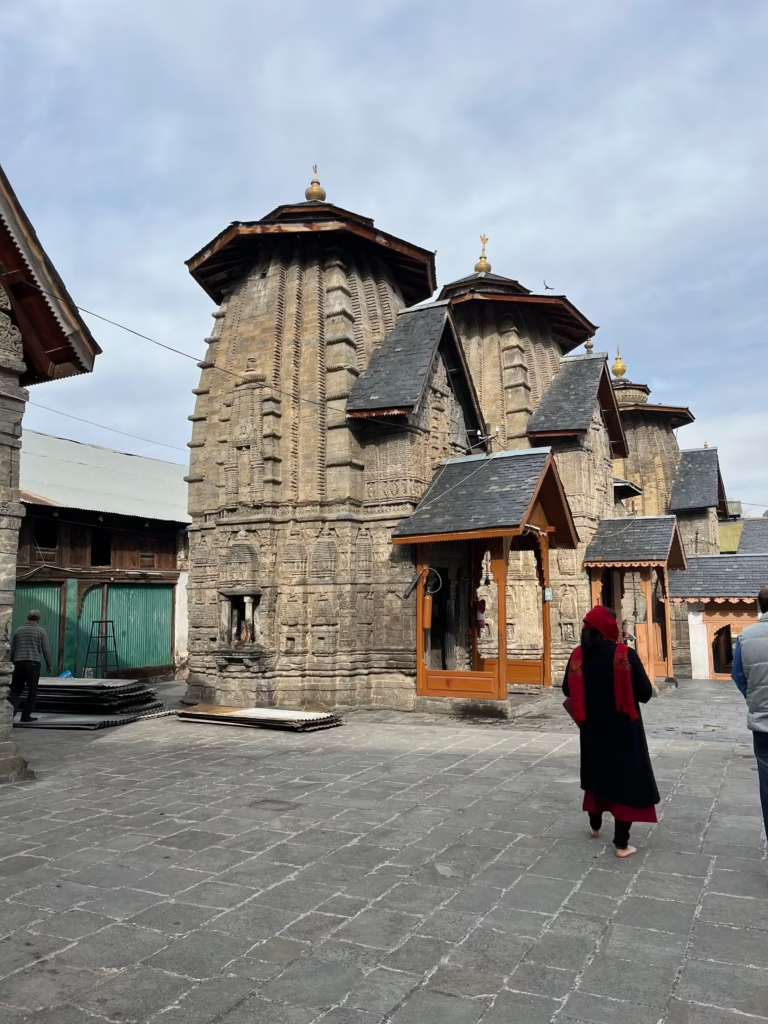
The small temple at the south end of the meadow is dedicated to Khajji Nag, the serpent deity who gives the place its name, and has been a site of active worship since at least the seventh century. It is not architecturally elaborate, and it does not need to be — the setting does the work. The temple sits at the edge of the clearing with the forest behind it and the meadow in front, and the combination of the devotional space and the natural landscape gives it a quality that more ornate temples in less remarkable settings lack.
Visit it briefly before or after walking the meadow. The ongoing worship at the temple — the fact that this place has been considered sacred for over a thousand years, and that people continue to come to it with that intention — adds a dimension to Khajjiar that the meadow alone, for all its beauty, does not fully provide.
Staying Versus Visiting — Why It Matters Here
Most people who come to Khajjiar come as part of a day trip from Dalhousie, which is approximately twenty-four kilometres away. They arrive at midday, spend two to three hours in the meadow, eat something at one of the basic establishments at the edge of the clearing, and return by evening. This is sufficient to see Khajjiar. It is not sufficient to experience it.
The meadow at the edges of the day — the early morning before the day visitors have arrived, the evening after they have left — is a different place from the midday version. The quality of the light changes. The sound level changes. The animals that find the busy midday period too much emerge again. The particular quality of stillness that the meadow is capable of — which is what most travellers are actually looking for when they describe why they found it memorable — is available almost exclusively outside the peak visitor hours.
Staying a night at one of the small properties at the edge of the meadow gives you two mornings and two evenings. That time is what converts a pleasant visit to Khajjiar into a genuine encounter with what the place actually is.
How Khajjiar Fits Into a Broader Trip
Khajjiar sits in the Chamba district of Himachal Pradesh, approximately twenty-four kilometres from Dalhousie and accessible by a road that winds through dense forest. Dalhousie — a colonial hill station with its own distinct character and a good base for exploring the broader region — is the most common starting point. A Khajjiar visit is often added to a Dalhousie trip as a day excursion, which is a reasonable way to include it in a broader Himachal itinerary.
For travellers who want to give Khajjiar proper time, staying a night at the meadow and treating it as a destination rather than an excursion is the better approach. Combine it with Dalhousie on either side — a night in Dalhousie, a night at Khajjiar, a return to Dalhousie or an onward journey toward Chamba town — and the small geography of the region becomes a complete circuit rather than a series of stops.
Chamba town itself, thirty-six kilometres from Khajjiar, is worth including for travellers with the time. It is an old riverside settlement with temple architecture and a craft tradition in Chamba rumal embroidery that is genuinely significant — and almost entirely off the standard tourist circuit. A broader Chamba district itinerary that includes Dalhousie, Khajjiar, and Chamba town gives you a complete and undervisited part of Himachal Pradesh.
Practical Notes
Getting there: Khajjiar is most commonly reached from Dalhousie, which is the nearest significant town and the base for most visitors to this part of Himachal. Dalhousie is accessible by road from Pathankot — the nearest major railhead, approximately eighty kilometres away — in approximately two and a half to three hours. From Pathankot, shared taxis and private vehicles connect to Dalhousie and onward to Khajjiar. The Khajjiar road from Dalhousie passes through dense deodar forest and is itself a part of the experience — allow forty-five minutes to an hour for the drive.
Activities at the meadow: Horse rides, zorbing, and various outdoor activities are offered at the main meadow area, primarily aimed at families with children. These are optional and straightforward. If you are travelling with young children, the availability of these activities makes the visit more engaging for them than it might otherwise be. If you are travelling without children and are here for the landscape, they are easy to ignore.
Accommodation: Options at Khajjiar itself are limited — a handful of small hotels and guesthouses at the edge of the meadow. The facilities are basic to modest. What they offer instead of elaborate amenities is location: being at the meadow rather than twenty-four kilometres away from it. For one or two nights, this trade-off is entirely worth it.
Freedom Trail India plans private journeys through Himachal Pradesh, including the Dalhousie and Chamba district. If you are thinking about a Himachal trip and want honest advice on how to structure it — we are glad to help.