The Place That Asks Nothing of You
Most travel destinations have a contract with the visitor. They offer activity, stimulation, things to see and do — and in return, the visitor keeps moving, keeps engaging, keeps extracting. The destination performs; you consume.
Kausani does not offer that contract.
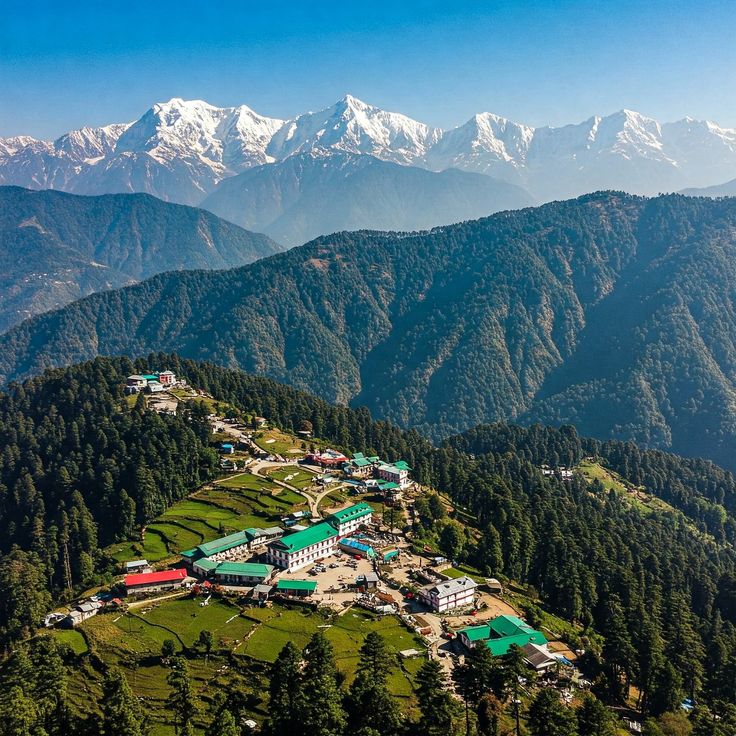
It sits in the Kumaon hills of Uttarakhand with a long, unhurried view of the central Himalayan range — Trishul, Nanda Devi, Panchachuli visible on clear days, stretching across more horizon than feels real — and it essentially asks you to sit down and look at it. There is no promenade. No primary activity that anchors the visit. No list of things that must be done before you can say you have seen the place.
This simplicity is either immediately appealing or slightly disorienting depending on the kind of traveller you are. If you need constant engagement to feel like a trip is working, Kausani will feel limited within a day. If you are the kind of person who has been waiting for permission to stop — to sit somewhere genuinely beautiful and do very little — Kausani is one of the best places in Uttarakhand to do it.
What Kausani Actually Is
Kausani is a small ridge-top town in the Kumaon region, roughly midway between Almora and Bageshwar. It is not particularly well-known outside India, and within India it tends to be overshadowed by the more famous Uttarakhand destinations. This is, from the visitor’s perspective, entirely to its advantage.
The town exists at an elevation that positions it directly across from a long stretch of high Himalayan peaks. On clear days, the panorama is extraordinary — not a glimpse of mountains between buildings but a continuous view stretching across the full width of the visible horizon, with peaks at elevations between 6,000 and 7,800 metres holding the skyline. Nanda Devi — at 7,816 metres, the highest peak entirely within India — is visible from here on clear days, which is not something that can be said from many accessible locations.
Mahatma Gandhi spent time here in 1929 and described the view as the “Switzerland of India” — a comparison that does not quite hold but conveys the scale of what he was looking at. The Anasakti Ashram where he stayed remains in the town and is worth a brief visit, less for its historical significance than for the garden terrace with the mountain view that apparently prompted the remark.
What the town does not have is equally worth understanding: no significant commercial district, no busy promenade, no major tourist infrastructure. The accommodation options are limited but include some genuinely good properties for a destination of this size. The food is simple. The evenings are quiet in the way that mountain evenings are quiet — audibly, not. just atmospherically.
When to Go — The View Is the Variable
The decision about when to visit Kausani is almost entirely about what you want to see, because the landscape changes substantially across the year.
- October through March is the primary window for clear mountain views. The post-monsoon air stays clean through the autumn and winter months, and the Himalayan panorama — particularly on crisp winter mornings — is at its most defined. January and February bring cold nights and sometimes snow on the higher slopes visible from town, which adds a visual dimension that the summer months lack. Days in winter are short but often brilliantly clear.
- April through June shifts the equation. The views are generally good but occasionally obscured by pre-monsoon haze, and the weather at ground level is more comfortable — warmer days, milder evenings, easier for spending time outdoors. Many visitors prefer this window for the simple reason that sitting outside with a mountain view is more pleasant when you are not cold. Both are valid; it depends on whether you prioritise the sharpness of the view or the comfort of the experience.
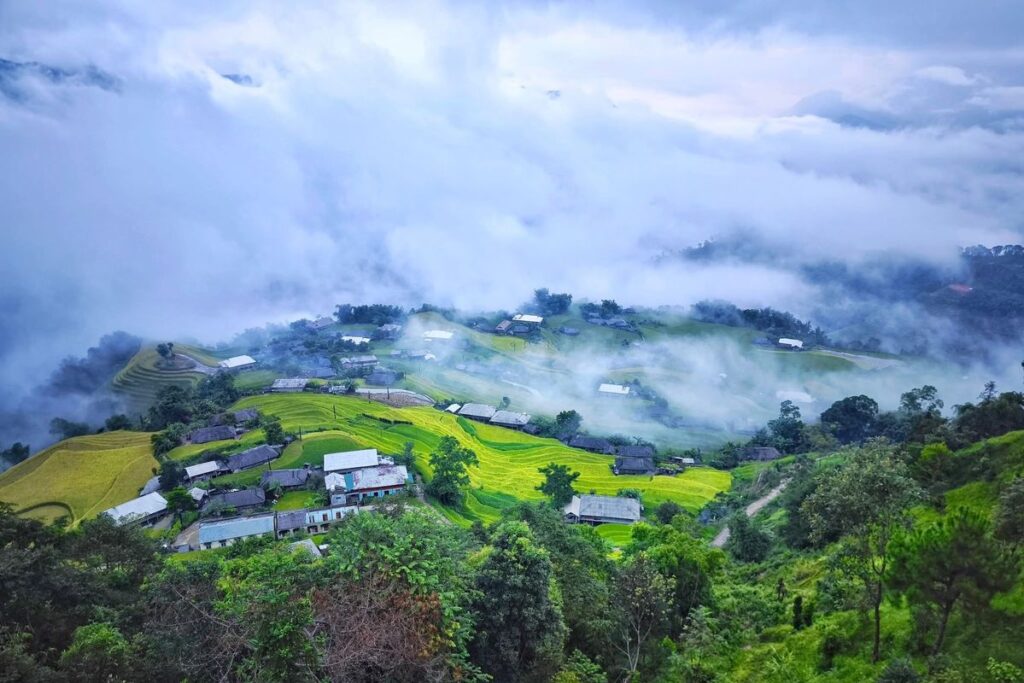
- Monsoon — July through September — is the season of trade-offs. The hills turn a deep, saturated green that is genuinely beautiful, and the clouds that move through and around the peaks create a landscape that changes minute by minute. But the distant mountain views disappear for long stretches, sometimes for days at a time. For a destination whose primary offering is the Himalayan panorama, this is a significant variable. Some travellers love monsoon Kausani for the intimacy it creates — the mountains are closer in feeling even when invisible — but it requires arriving without the expectation of clear views.
The Mountain View — What It Actually Takes to Experience It
There is a particular trap in visiting a place known primarily for one thing: you arrive, you see the thing, you feel it should have produced more feeling than it did, and you conclude that the destination was overhyped.
The mountain view at Kausani is not a single event. It is a sustained experience that unfolds over time.
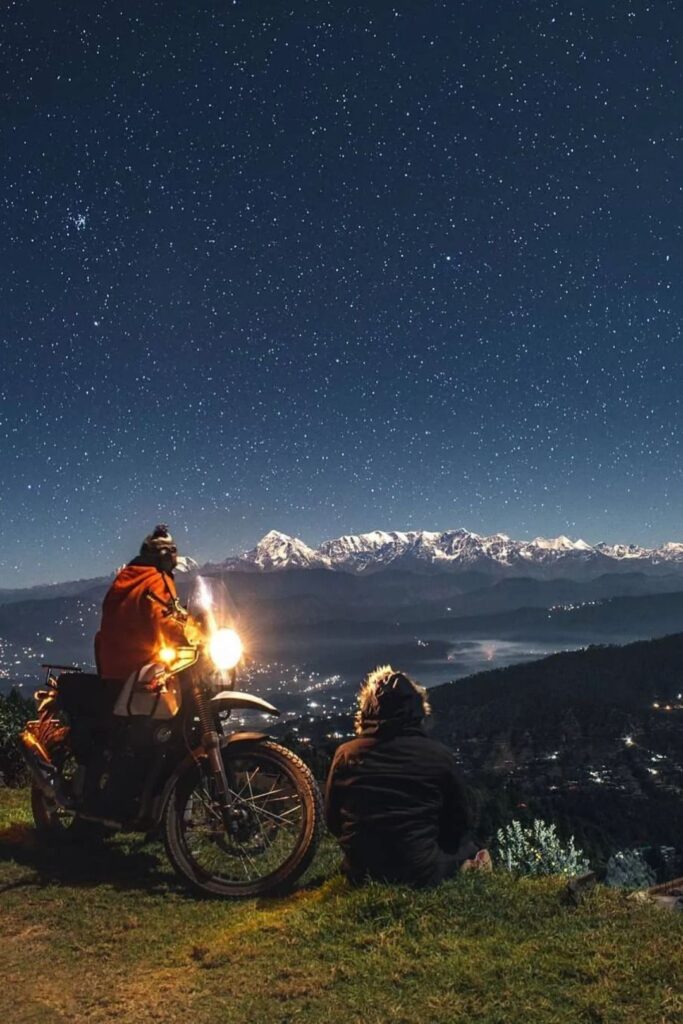
The peaks look different at every hour. Pre-dawn, on the clearest mornings, they emerge from darkness in shades of grey that gradually resolve into white and rock and shadow as the sky brightens. The first direct sunlight hits the highest peaks while the valley below is still in darkness — for a period of twenty or thirty minutes, the mountains glow in isolation, lit from above while everything else waits for the day to arrive. This is worth waking up for. It cannot be scheduled or guaranteed, but when it happens it is one of those natural events that resets your sense of scale.
By mid-morning, the light has flattened and the peaks look closer to their photographic representations — impressive but less alive. By late afternoon, as the light angles in from the west, colour returns to the slopes. By evening, the peaks hold the last of the light while the valley below has already darkened.
A single day in Kausani gives you one reading of this. Three days gives you something more: the cumulative understanding of how the mountains behave across different lights, different cloud conditions, different mornings. You stop being a viewer and start being, in some small way, a resident — someone who lives with this view rather than visiting it.
That shift is what Kausani is actually offering. It takes time to arrive.
What to Do — and the Importance of Doing Less Than You Think
Kausani has a small number of specific attractions and a larger amount of simply being there. Matching these two things to the right proportion is what makes the trip work.
The Anasakti Ashram is a twenty-minute walk from the main part of town and worth the detour — the garden terrace has an open mountain view and the simple, uncluttered quality of the space is a good complement to the rest of what Kausani offers. The small museum inside documents Gandhi’s time here and gives context to the town’s position in a specific moment of Indian history.
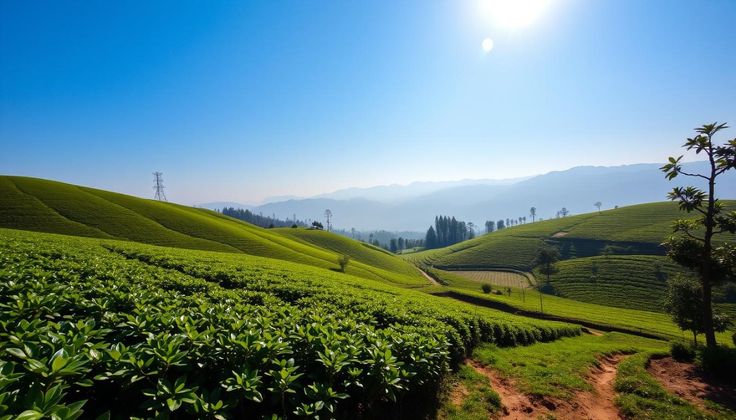
The tea gardens on the outskirts of the town — Kausani produces a well-regarded Himalayan tea — are worth a slow walk through, particularly in the early morning when the light sits low over the terraced slopes. It is not a managed tourist experience; you walk through a working tea estate, which is precisely what makes it interesting.
The walks around and below the ridge are the main activity, though “activity” is perhaps too strong a word. There are paths that lead through forest, past small villages, along stretches where the mountain view opens and closes as the terrain shifts. None of them require a guide or significant effort. Most of them lead somewhere worth going and return you to where you started with the particular satisfaction of having moved through a landscape rather than past it.
What Kausani does not need is a packed itinerary. Two or three planned things per day is too many. One thing, plus unstructured time, plus the view — that is the right ratio.
Where You Stay — The Single Most Important Decision
In Kausani, the accommodation question reduces to one variable above all others: does the room face the mountains?
This is not a preference. It is the difference between a trip where the Himalayan view is present throughout — where you wake up to it, where it is visible from where you sit and drink your morning tea, where it is the last thing you see before the light fades — and a trip where the view is something you go out to find. The first version of Kausani is extraordinary. The second version is pleasant but misses the essential quality of the place.
When looking at properties, ask specifically: is the mountain view unobstructed from the room and the balcony or sit-out? Some properties have partial views, some have clear views from common areas but not rooms, and some face away from the mountains entirely. The difference in price between a mountain-view room and one without is usually small. The difference in experience is significant.
There are a handful of well-positioned properties in Kausani that understand this and have been built around it. A cold clear morning, a cup of tea, the Trishul and Nanda Devi peaks fully visible across the valley — this is not an incidental bonus. This is the point.
How Many Days — and Why Rushing It Wastes the Journey
Two nights is the minimum. Three nights is what we recommend.
The logic is straightforward: getting to Kausani takes most of a day from the nearest major town. Leaving takes most of a day back. A two-night stay leaves you one full day in the place. One full day is enough for a first impression — enough to understand what Kausani is — but not enough for the experience to settle into something that stays with you.
Three nights gives you two full days, which is the minimum for the gradual, accumulative quality of the place to work on you properly. The second morning is different from the first. The mountains look different. You have started to know the view rather than just see it. That distinction, small as it sounds, is what makes certain trips memorable and others merely pleasant.
Kausani also works well as part of a broader Kumaon circuit. Almora is two hours away — a town with its own distinct character and history that complements what Kausani offers. Ranikhet is roughly the same distance in another direction. Munsiyari, for those with more time and appetite for remoteness, is further but an entirely different register of Himalayan experience. Building Kausani into a Kumaon loop rather than treating it as a standalone destination makes the most of the journey required to reach this part of Uttarakhand.
A Few Practical Notes
Getting there: Kausani is most commonly approached from Kathgodam, the nearest major railhead, which is well-connected to Delhi. The drive from Kathgodam to Kausani takes approximately four to five hours through the Kumaon hills. Almora, roughly halfway, is a natural overnight stop for those who want to break the journey. Alternatively, Kausani can be combined with other Kumaon destinations — Ranikhet, Binsar, Bageshwar — into a circuit that makes the long journey worthwhile.
Road conditions: The roads in this part of Kumaon are mountain roads — narrow, winding, and occasionally subject to disruption during and after monsoon. Travel with a driver who knows the region. Build flexibility into arrival and departure days.
Connectivity: Mobile signal in Kausani is limited and intermittent. This is worth knowing, and — as with Munsiyari — most visitors find it less of a problem than they expected.
Freedom Trail India plans private journeys through Kausani, the broader Kumaon region, and across Uttarakhand. If you are thinking about a slow, mountain-centred trip to this part of India — we are glad to help you build something that makes sense.