A City That Is Already in Motion When You Arrive
Most cities let you ease in. You arrive, find your bearings, begin to understand the place at your own pace. Haridwar does not work that way preamble.
This directness is what defines Haridwar and distinguishes it from Rishikesh, which is only twenty-five kilometres upstream but occupies a completely different emotional register. Rishikesh allows you to step in and out of its spiritual dimension — to be at the aarti one evening and at a riverside café the next morning, choosing your level of engagement. Haridwar does not offer that option. It has one dominant mode and you are either inside it or standing at the edge of it, watching.
For travellers who want to understand what a living pilgrimage city feels like — not as spectacle but as lived reality — Haridwar is one of the most direct encounters with that experience that India offers.
What Haridwar Actually Is
Haridwar is one of the seven sacred cities of Hinduism, marking the point where the Ganga leaves the Himalayan foothills and enters the plains. The name itself means Gateway to God — Hari referring to Vishnu, dwar meaning door. For practicing Hindus, the water at Haridwar carries a particular sanctity tied to this geography: it is the last point at which the river is considered to flow from the mountains, and the first point at which millions of pilgrims from across India can access it.
The city has operated as a pilgrimage centre for centuries, and what is striking about it today is the continuity of that function. Haridwar has not become primarily a tourist destination with a religious atmosphere layered on top — it remains a functioning pilgrimage city that also receives tourists, and the difference is felt immediately. The people moving through the ghats are mostly not visitors in the conventional sense. They are there to do something specific, with the kind of quiet intention that gives the entire place its particular feeling.
Understanding this before you visit changes how you experience it. You are not the audience. You are a witness to something that would be happening whether you were there or not. That position — of observer rather than consumer — is the right way to approach Haridwar.
When to Go — and What Each Season Feels Like
- October through March is the most comfortable window for most visitors. The weather is cool, walking through the ghats and spending extended time near the river is pleasant, and the city operates at a pace that is busy but manageable. Winter mornings at the ghats — cold, misty, the river moving fast between stone steps — are a version of Haridwar that many visitors remember most clearly.
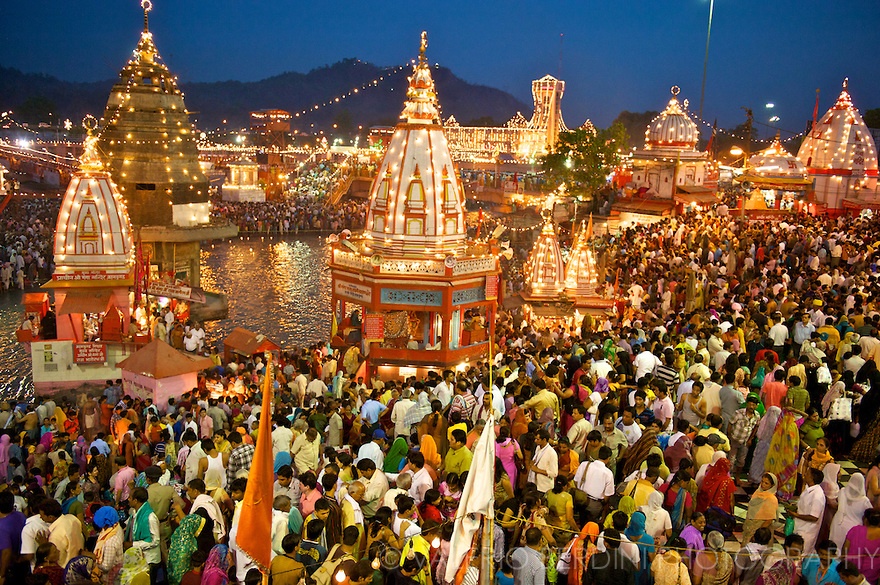
- The Kumbh Mela and Ardh Kumbh cycle changes Haridwar’s scale entirely. These gatherings — held on a rotational calendar that brings tens of millions of pilgrims to the city over a period of weeks — are among the largest human gatherings on earth. The experience is extraordinary and unlike anything else in the world, but it requires specific planning: accommodation books months in advance, movement through the city becomes genuinely difficult, and the already-dense atmosphere of Haridwar amplifies into something categorically different. If your visit coincides with a major Kumbh period, arrive knowing what you are walking into and plan accordingly.
- Summer — April through June — is warm but the city functions as it always does. The heat makes extended time at the ghats less comfortable in the middle hours of the day, but mornings and evenings remain accessible and the pilgrim flow does not reduce with the temperature.
- Monsoon brings a different quality to the city. The Ganga rises significantly — the ghats that are wide and accessible in winter become narrow and partially submerged, and the river’s power becomes unmistakably visible. The atmosphere changes with the river. Some visitors find this version of Haridwar the most viscerally impressive. It is also the most physically demanding to navigate.
Har Ki Pauri — The Centre That Everything Circles
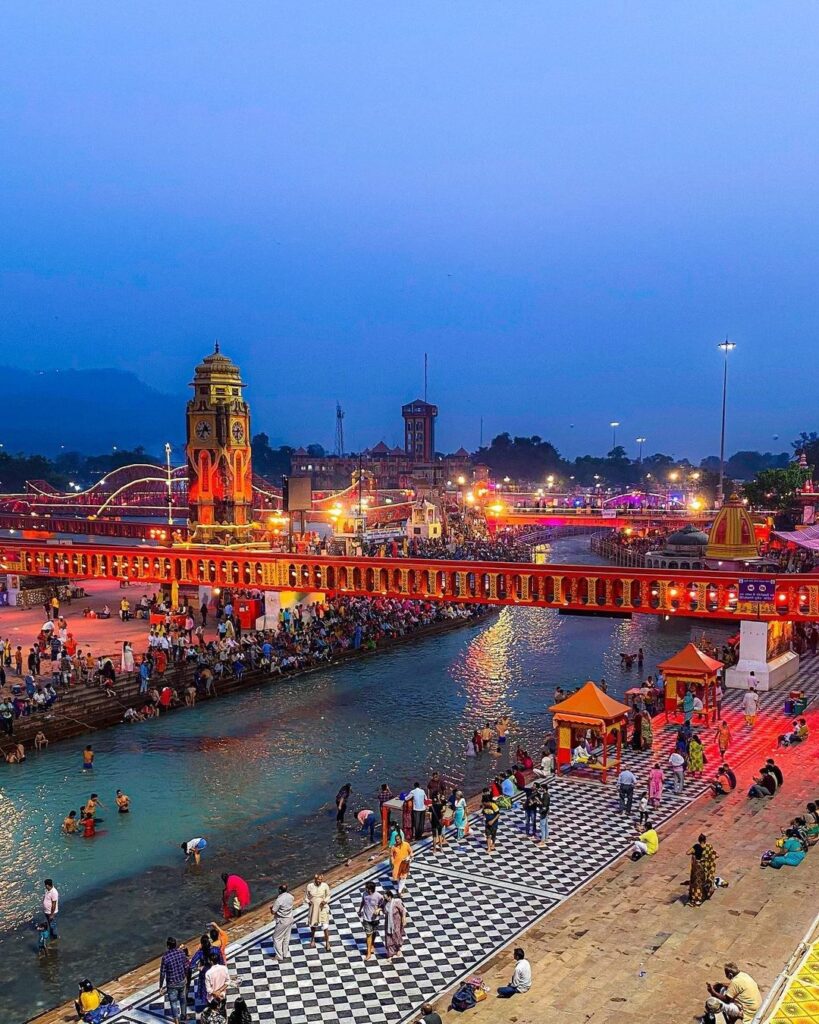
Har Ki Pauri is the primary ghat of Haridwar and the point around which the city’s spiritual life concentrates. Literally translated as “Footstep of God,” it marks the place where, according to Hindu belief, Vishnu left an impression in the stone, and where the Ganga is considered to be at its most sacred at this location.
What you find there on any given day — not during a festival, just on an ordinary morning — is purposeful activity on a scale that most visitors are not prepared for. People bathe in the river despite the current, which is held back by chains and barriers specifically for this purpose. Priests sit at small stations conducting rituals for families who have come specifically to perform them. The water is continuously offered back to the river in cupped hands — a gesture repeated thousands of times a day by thousands of different people, each one completing a circuit that began somewhere else in India and ends here, at this ghat, with the Ganga.
The physical experience of standing at Har Ki Pauri — the sound, the movement, the scale of collective intention — is unlike anything that can be adequately described. It needs to be stood in. Give it time: not a rushed fifteen-minute visit between other things, but enough time to let the rhythm of the place register. An hour at the ghats in the morning, when the activity is different from the evening, is a different experience from an hour in the evening before the aarti. Both are worth having.
The Evening Aarti — Collective, Not Ceremonial
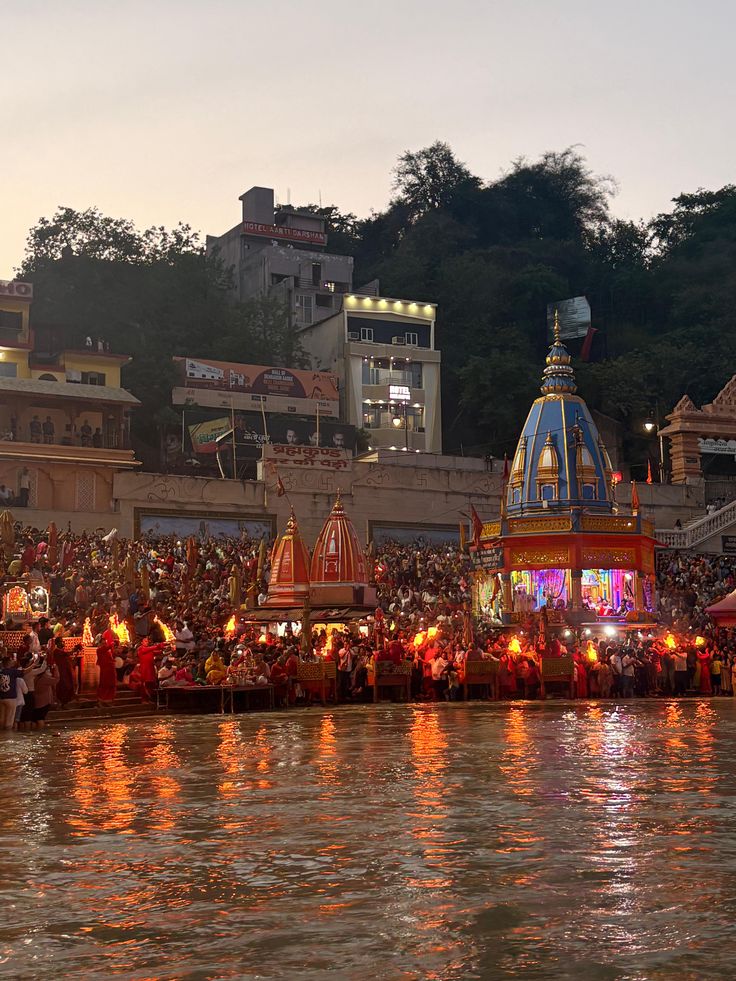
The Ganga aarti at Har Ki Pauri happens every evening without exception. It has been happening, in some form, for a very long time. The version you witness today is large, coordinated, and involves dozens of priests with large lamps conducting a synchronized ritual that builds in sound and movement over approximately forty-five minutes.
The first thing to understand is scale. This is not the intimate aarti of a small temple or the modest ceremony at Rishikesh. It is loud, densely crowded, and deliberately overwhelming in the way that large collective rituals are overwhelming — the individual is absorbed into something much larger than themselves, which is precisely the point.
The second thing to understand is that it is not a performance. It is not staged for visitors. The priests conducting it, the pilgrims wading in for a final bath before the lamps are lit, the families releasing small leaf boats with candles onto the current — all of this is religious practice, carried out with the same intention it has always been carried out with. Your presence as an outside observer is accommodated but not catered to.
Arrive at least thirty minutes before the aarti begins to find a position at the ghat. The earlier you arrive, the closer you can get to the main ceremony. Stand rather than sit if you can — the movement of the crowd during the aarti makes seated positions vulnerable to disruption. Leave your footwear at the designated areas before approaching the main ghat steps. Then simply be there. The aarti does not require active participation from non-Hindu visitors. It requires presence and a willingness to be moved by something that has nothing to do with your understanding of it.
Beyond the Ghats — What the Rest of the City Offers
Most visitors to Haridwar concentrate their time at Har Ki Pauri and the surrounding ghat area. This makes sense — the ghats are the heart of the city — but it leaves out a dimension of Haridwar that gives context to everything else.
The lanes and markets that run back from the ghats into the city are active, dense, and genuinely interesting for anyone willing to move through them without a specific destination. Pilgrim supply shops selling ritual items — brass lamps, flower offerings, sacred thread, camphor — sit alongside food stalls serving the particular vegetarian food that a city defined by religious practice produces: pure, simple, made for people who are here for reasons other than eating. The food is not the draw, but eating at a simple ghat-side kitchen is a more honest version of Haridwar than eating at a tourist-facing restaurant.
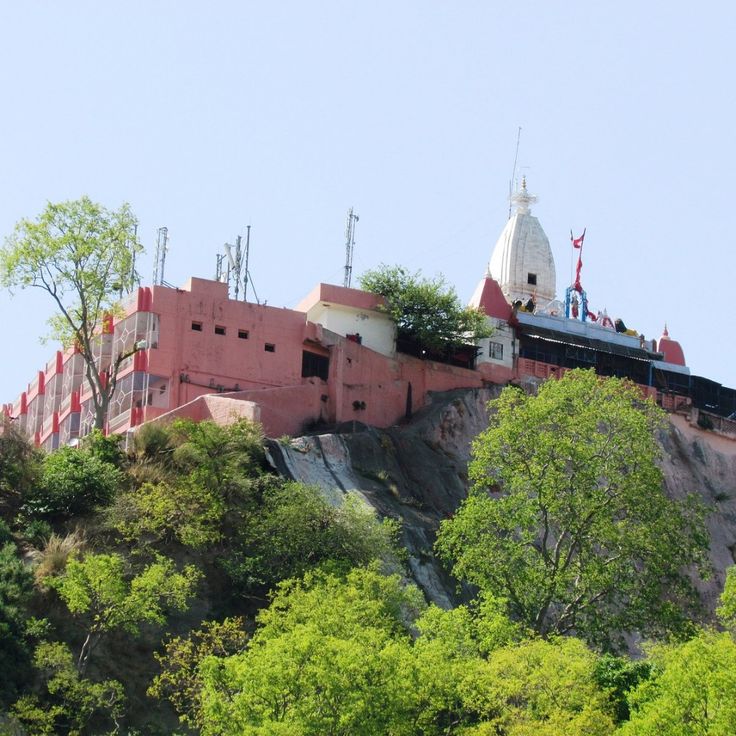
The Mansa Devi temple, reachable by ropeway from the main ghat area, sits on a hill above the city with a view down over the Ganga and the rooftops. It is a functioning temple rather than a viewpoint, and the experience there is shaped more by the pilgrims visiting it than by the landscape below. Both are worth paying attention to.The Chilla wildlife sanctuary, on the edge of the city, marks the boundary between the urban pilgrimage centre and the forest that begins where Haridwar ends. It is accessible as a short excursion and offers a sharp contrast to the density of the main city — though it should be approached with realistic expectations about wildlife sighting probability on a short visit.
How Many Days — and Why Passing Through Is a Mistake
One night, two days is the minimum for Haridwar to make sense. Many people arrive in the late afternoon, attend the evening aarti, and leave the following morning — and while this covers the most visible experience, it misses the quality of the city at different hours.
The morning at Har Ki Pauri is completely different from the evening. The light, the pace, the nature of the activity — a quiet morning at the ghats when pilgrims are bathing and the day’s ritual has just begun tells you something about Haridwar that the dramatic evening aarti does not. See both. They are two chapters of the same place.
Two nights gives you two mornings and two evenings, which is enough to experience Haridwar rather than simply witness it. It is also enough time for the city’s rhythm — which initially feels overwhelming — to begin to feel familiar. That shift from overwhelm to familiarity is part of what Haridwar gives to the visitors who stay long enough to reach it.
Haridwar also connects naturally with Rishikesh — the two cities are twenty-five kilometres apart and are often visited together. Doing them in sequence, with a night in each, gives you a contrast that makes both places more legible: Haridwar’s uncompromising, river-centred intensity followed by Rishikesh’s more layered, accessible energy, or the reverse. The sequence is worth thinking about deliberately rather than choosing arbitrarily.
Where to Stay — Proximity Over Everything
In Haridwar, the single most useful accommodation principle is proximity to the ghats.
The city is not large, but the area immediately around Har Ki Pauri operates differently from areas even a short distance away. Staying close means you can walk to the ghats in the early morning without organising transport — which matters, because the morning experience is worth getting to easily. It means the evening aarti is accessible on foot. It means you move with the city rather than travelling to and from it.
The accommodation available near the ghats ranges from basic to comfortable. It is not a destination for luxury hotels — there are options at higher price points but they tend to be further from the ghat area, which defeats the primary purpose. A clean, functional room close to Har Ki Pauri serves Haridwar better than a more comfortable room that requires a vehicle to reach the river.
A Few Practical Notes
- Getting there: Haridwar is well-connected to Delhi by train — multiple daily services on a route that takes approximately four to five hours. It is also a natural stopping point on the road to Rishikesh, Dehradun, and the broader Uttarakhand circuit. Most visitors to Rishikesh or the Kumaon hills pass through or near Haridwar, making it straightforward to include.
- Photography at the ghats: Photography is generally permitted at Har Ki Pauri and during the aarti, but it requires sensitivity to context. People at the ghats are engaged in religious practice, not providing a backdrop for travel photographs. Ask before pointing a camera at individuals. During the aarti itself, keep photography unobtrusive — the experience of being present without a screen between you and the ceremony is worth more than the photographs.
- Dress and behaviour: Haridwar is a religious city and the expectations around dress and behaviour at the ghats reflect that. Covered shoulders and legs are appropriate. Removing footwear before approaching the main ghat steps is required. The city is almost entirely vegetarian — meat is not available in the ghat area and alcohol is not available anywhere in Haridwar. These are not inconveniences; they are the conditions of a place that has maintained a particular character for a very long time.
Freedom Trail India plans private journeys through Haridwar, Rishikesh, and across the broader Uttarakhand region. If you are thinking about a spiritual travel circuit or a first-time North India itinerary that includes these destinations — we are glad to help you design something that holds together.